Best Care. Best Results.
Specialists in Blepharoplasty
Blepharoplasty is an operation that removes excess skin or fat from the lower or upper eyelids. It is often undertaken for both cosmetic and functional reasons.
Our specialist oculoplastic surgeons provide expert eyelid assessments to determine whether a blepharoplasty operation may help enhance your appearance, restore your vision, or relieve discomfort caused by drooping or heavy eyelids.
Explore your Blepharoplasty options with a leading oculoplastic surgeon today.

World leading surgeons
5 star blepharoplasty surgery
No wait times
Consultant-led care
Why choose Sapphire?
- World leading surgeons
- No wait times
- State-of-the-Art Facilities
- Personalised, consultant-led care
- Choose your lens
- Cutting-edge treatments
- Pain-free procedure
- We only look after eyes
- Practical, honest and fast
- Transparent pricing
- Suited to your lifestyle
- No need for a clinical referral
The Sapphire Journey
At Sapphire Eye Care, we are committed to delivering a premium ophthalmology experience tailored to your needs along each step of the way.
You might notice that your peripheral vision is impaired.
As we age, the skin around our eyes can lose elasticity and begin to droop.
In the upper eyelids, we call it dermatochalasis, and it can sometimes affect your visual field, making it harder to see to the sides or above. In the lower lids, ageing can cause fat to become more prominent, resulting in puffiness or under-eye bags.
Blepharoplasty can significantly improve both eye function and aesthetic appearance. Our team will carry out a detailed consultation to assess the structure and health of your eyelids and discuss the best approach moving forward for you.




Meet our Blepharoplasty surgeons
Each of our surgeons is a leader in their field, committed to advancing eye care through innovative techniques and personalised patient journeys. Our Ophthalmologists are not only chosen for their technical expertise but also for their dedication to patient outcomes and ongoing care – click their profiles below to learn more about each of them.



Our clinics
We see patients all over the south of England in our clinics. See our consultant locations:
Hampshire, Dorset, Surrey, Sussex, Berkshire and bordering counties.

Frequently Asked Questions
What is Dermatochalasis?
Dermatochalasis is excess of eyelid skin. It can present as an extra fold of skin, which may overhang the upper eyelashes. It is caused by the skin losing its elasticity, usually due to age but is also seen in some medical conditions such as Thyroid related. It may be associated with prolapse of orbital fat, causing the eyelid to bulge (eye bags). This may occur in the upper or lower eyelid. The lower lid may be lax or loose, which may cause it to sag or hang lower than in youth.
How long is the average wait time to see a Sapphire Ophthalmologist?
Sapphire Eye Care prides itself on offering timely appointments. The average wait time can vary, but we strive to see patients as soon as possible, often within one to two weeks. For the most accurate wait times, please schedule an appointment by contacting our team here.
What is Blepharoplasty Surgery?
A blepharoplasty is an operation to rejuvenate the eyelids and, in some cases, can improve vision where excess skin is obscuring it.
It usually involves the removal of excess eyelid skin.
Depending on an individual, muscle or fat underlying the skin may also be removed, repositioned or tightened surgically.
The procedure can be carried out in the upper or lower eyelid
Upper eyelid blepharoplasty:
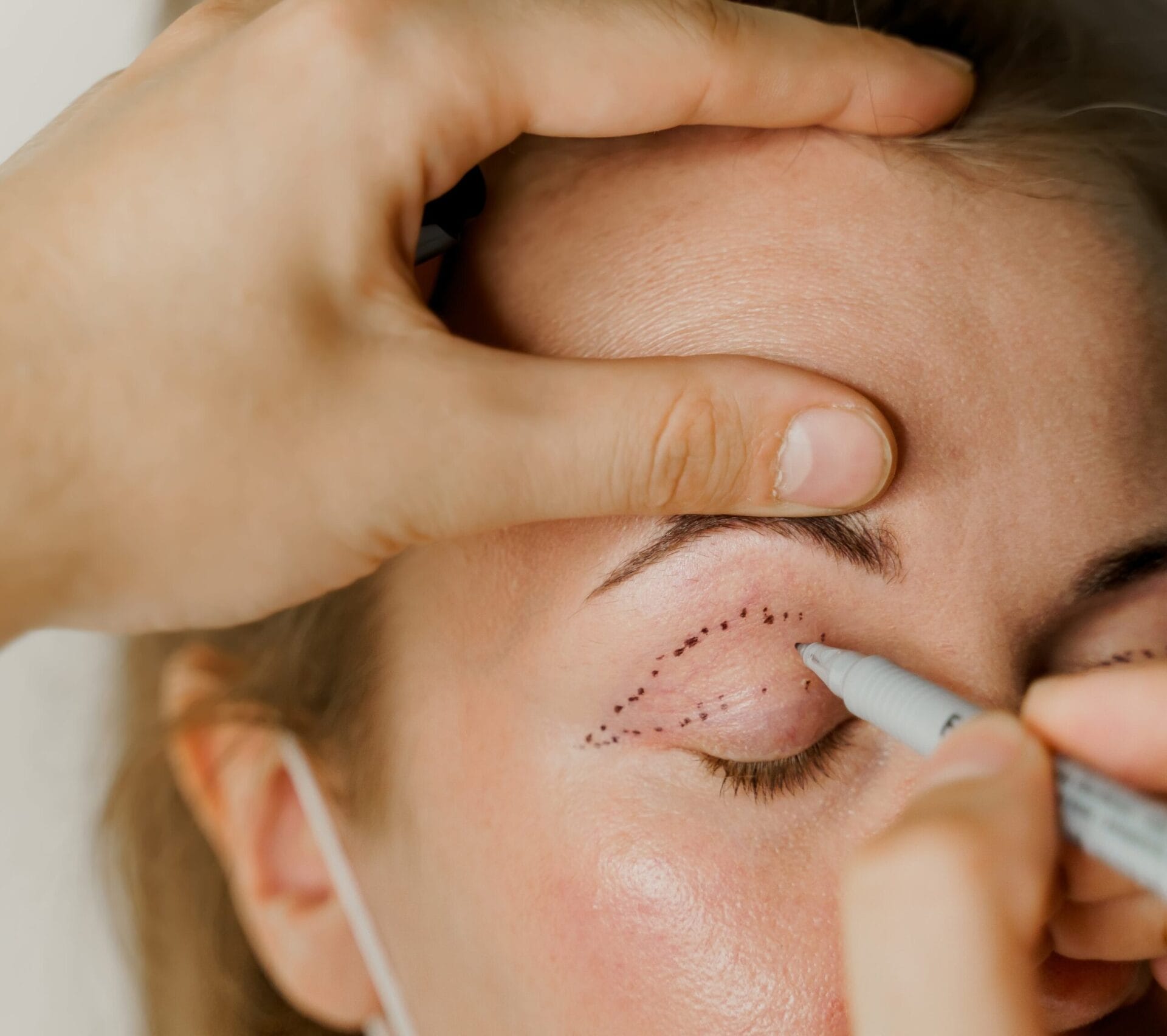
At the beginning of the operation, the amount of skin to be removed will be carefully assessed. Marks will be drawn on the eyelid with a sterile marking pen to assist the surgeon during the procedure.
The incision is based in the skin crease of the upper lid, which helps to minimise any sign that you have had upper lid surgery.
After this, local anaesthetic will be injected under the skin of the eyelid and excess skin is then removed.
Depending on your particular needs, the muscle beneath the skin may be preserved or partially removed.
If there is fat prolapse, this may be treated with partial fat removal or repositioning.
Sutures are placed to reform the natural skin crease in the eyelid.
The skin edges are sutured together with either a continuous suture that is removed one week later or absorbable sutures that will naturally fall out after 2-3 weeks.
It may be performed alone or in conjunction with other procedures such as lower eyelid surgery, ptosis surgery or brow surgery.
Lower eyelid blepharoplasty:
There are several elements to lower lid blepharoplasty: skin, muscle, fat and eyelid laxity. The procedure will be tailored to your needs.
Fat prolapse in the lower eyelid gives the appearance of ‘eye bags’. This fat can be excised or repositioned over the orbital rim to create a smoother transition from the eyelid into the cheek.
Surgery on the prolapsed fat may be done without a skin incision from the inside of the eyelid – transconjunctival or via a skin incision just beneath the eyelashes – transcutaneous.
The lower eyelid usually needs to be tightened at the time of surgery. Even a small amount of lid laxity can lead to postoperative lower lid retraction or ectropion if not addressed at the time of surgery.
The orbicularis muscle, which lies directly beneath the skin is often tightened by placing sutures from it to the bony rim of the orbit – ‘orbicularis suspension’.
Lower eyelid skin is excised in much smaller amounts than in the upper lid. This is to avoid the unwanted side effect following surgery of eyelid retraction.
How does Sapphire Eye Care ensure the best outcomes for patients?
With a team of highly qualified and experienced Ophthalmologists, we are committed to continuous learning and improvement, aiming for the highest standards in patient care and surgical outcomes.
After surgery, you may experience some pain. Simple paracetamol is usually enough to control this.
The eyelids will be bruised and swollen. Bruising will take approximately 2 weeks to settle. Swelling is greatly reduced after 2 weeks but may not completely resolve for several months.
Some people report not feeling ‘back to normal’ for up to 6 months after surgery.
Initially, it may feel difficult for you to close your eyelids and this will be managed with eye ointments.
It is important not to have surgery too close to important events, in case you have not fully recovered in time.
The whole suite of lenses available to the public is currently not available on the NHS. At Sapphire Eye Care we pride ourselves on being able to offer the entire suite of lenses, from Toric lenses to multifocal lenses, from monofocal lenses to extended depth of focus lenses.
As with spectacle lenses, there are different implant lenses available. You may be given a choice of using a regular monofocal lens (single-vision power), or a multifocal lens which is designed to give you a degree of spectacle independence for most everyday tasks.
We will discuss with you the type of implant lens that will best suit your needs, and the visual outcome you can expect.
What is the recovery process like post-cataract surgery at Sapphire Eye Care?
What makes Sapphire Eye Care different from other ophthalmology clinics?
Our clinics combine the latest advancements in eye care with a personalised approach that considers each patient’s unique needs, ensuring an experience that’s not just effective but also reassuring and comfortable.