Glaucoma
If you have a diagnosis of Glaucoma, you may be worried about whether or not you are able to drive.
Glaucoma is not an eye disease that has early symptoms and so the amount of sight affected by the disease is assessed by a specialist optometrist or your ophthalmologist.
Glaucoma is one of the notifiable eye conditions that the DVLA require you to declare, but only if it is in BOTH eyes for car and motorcycle licence holders or in a remaining eye when there is only one eye with good sight.
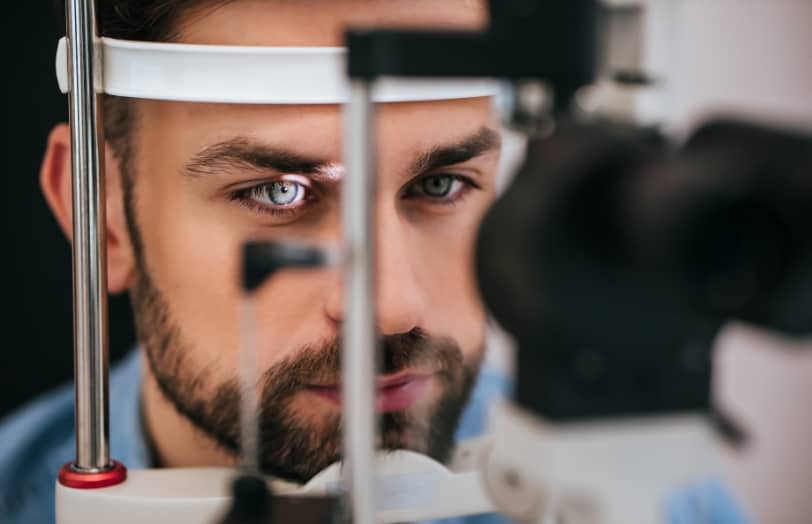
Your optometrist and your ophthalmologist will see you regularly to check that your glaucoma treatment is still working for you. As part of these tests, you will have a vision check with each eye on a standard letter chart and a visual field test, which checks for any gaps or loss of sensitivity in your peripheral vision.
The field of vision tests done by your ophthalmology outpatients’ team are important diagnostic checks for assessing the stability or progression of your glaucoma. It is not the same as the DVLA driving visual fields test, which is done by a contracted organisation.
The DVLA has a contract with certain optometrists who are paid to perform specialist driving visual field tests, and the results are sent to the DVLA. This is called an Esterman Binocular visual field test and is performed with both eyes together with your glasses on.
Will I have to stop driving if I have Glaucoma?
Provided that your vision remains within the DVLA standards for driving, there is no reason for you to stop driving.
The DVLA assesses your vision standard at regular intervals to make sure you are safe to retain your licence.
How might Glaucoma affect my vision for driving?
Glaucoma generally doesn’t affect your ‘letter chart’ vision immediately, but it can affect other parts of your sight. Because Glaucoma is a very slowly progressive condition, you tend not to notice the gradual changes like you would if it were a sudden change. That is what makes it so hard to comprehend as a patient with the disease.
- Contrast – That means that things may gradually get dimmer as the optic nerve is damaged, rather like turning down the dial on a light switch. So, your sight in low-level light, such as towards the end of the day, on foggy or wintery overcast days, may be impacted.
- Peripheral Vision – Glaucoma affects distinct large arcs of the peripheral vision, which can join together to make a ‘ring doughnut’ type shape of blind patches. When you have both eyes open, you don’t tend to notice these patches – although you might knock things over more often, bump into things or miss your footing on a shallow step. But in a car, driving at speed, missing objects that fall into these blind spots can be devastating. That is why peripheral vision checks are so important for drivers.
- Night Vision – Our peripheral vision is almost completely responsible for our ability to see in darkened conditions. It might seem obvious, but seeing in the dark and being aware of potential hazards is even more important in the dark. So, glaucoma patients can find this especially challenging.
- Dazzle and Glare – When we get dazzled by bright lights, it takes a few seconds to recover from the bright light. However, with glaucoma, the ability to adapt from light to dark and dark to light is severely affected. Glare from low-level sunshine, headlamps, bicycle lamps, or even reflections from buildings or water can cause patients significantly more trouble as their sight recovers. This is dangerous when driving and is particularly troublesome when the visual field is affected by glaucoma.
- Flicker in Dappled light – Similarly to dazzle and glare, drivers with glaucoma experience flicker from sideways sunlight through trees and hedges as visually disorientating. It puts pedestrians, animals, cyclists and other vehicles at risk of not being seen in time to stop.
Who has the responsibility of reporting my Glaucoma to the DVLA?
There are certain types of eye condition which require the declaration and reporting to the DVLA.
- If you drive a car or a motorcycle, it is your responsibility to declare this to the DVLA if you have glaucoma in both eyes.
- If one of your eyes is lazy, has poor or little vision, and you have glaucoma in your ‘better eye’ (your only useful eye), then you must also declare your Glaucoma to the DVLA.
- If you drive a bus, lorry or coach, it is your responsibility to declare this to the DVLA if you have glaucoma in one eye or both eyes.
You can report it here.
You will need to submit a V1 health declaration if you drive a car or a motorcycle.
If you drive a bus, lorry or coach, you will need to submit a V 1V health declaration.
(You can be fined up to £1,000 if you do not tell DVLA about a medical condition that affects your driving. You may be prosecuted if you’re involved in an accident as a result.)
What happens when I report my eye condition to the DVLA?
When you send a V1 declaration to the DVLA to tell them about your eye condition, they will send you to a contracted optician to perform specific tests, which you do not have to pay for. The results of these tests are sent back to the DVLA, who have a team of specialists who consider all of the medical evidence gathered, including the results of the eye test, as part of the driving licence application.
If your own Optometrist or Ophthalmologist has the ability to conduct an Esterman binocular field of vision test, and if it is more convenient for you or it is your choice that you have this test done by a professional whom you know, then they can also submit this to the DVLA on your behalf. You will, however, need to pay a fee for this service, and there is no guarantee that the DVLA will accept an alternative provider of the field tests. It is a good idea to check with the DVLA first.
What are the legal standards of vision for driving a car or motorcycle?
- You can read a number plate from 20 metres away – with your distance glasses on (equivalent to 6/12 on the Snellen letter chart with both eyes open and corrective glasses on if worn for driving). This is the minimum standard of vision.
- Have no double vision – with your glasses on
- Have a minimum of 120 degrees of horizontal visual field with ≥50 degrees of field on either side of central fixation. No defects should be present within the central 20 degrees of vision.
What are the legal standards of vision for driving a lorry or a bus?
- You must have a visual acuity at least 0.8 (6/7.5) measured on the Snellen scale in your best eye and at least 0.1 (6/60) on the Snellen scale in the other eye.
- You can reach this standard using glasses with a corrective power not more than (+) 8 dioptres, or with contact lenses. (There’s no specific limit for the corrective power of contact lenses.)
- You must have an uninterrupted horizontal visual field of at least 160 degrees with an extension of at least 70 degrees left and right of central fixation and 30 degrees up and down. No defects should be present within a radius of the central 30 degrees.
- You must inform the DVLA if you have any eyesight problem that affects either eye.
How can I prevent my Glaucoma from stopping me from driving?
When you receive a diagnosis of Glaucoma, it can be a very worrying and confusing time. Although the disease is not preventable, there are many treatment options available to slow the progression of the disease for many years into old age, when other factors may stop you from driving first.
You will be able to discuss your treatment options with your ophthalmologist, who will have seen many people in a similar situation to the one you are in, and they can help tailor your treatment to suit you and your glaucoma.
At Sapphire Eye Care, our expert Glaucoma team can discuss your glaucoma diagnosis and treatment options with you and help you make the best decision for your eye care based on the latest technology and research.
Further support:
There is lots of support for Glaucoma patients and information on updates to treatment and research:
Glaucoma UK – https://glaucoma.uk
RNIB – Glaucoma – information and guide I RNIB | RNIB
There are regional Glaucoma Support Groups in most locations around the UK.